Tuesday, June 19, 2007

There's little that's green about the Amazon


Amazon just sent me an email. Their algorithm figured that if I bought "Worldchanging" then I'm sure to like a whole slew of books about being green.... You know the drill.


And that's totally true. So in my best effort to be green-- halo adorned-- I'm going to order all of these books and have Amazon ship them to me in individual cardboard boxes that could each house a moose, stuffed with plastic balloons for stability, glossy coupons for my next internet purchase, and a little extra cardboard and plastic wrap for protection within the moose box. And I'm gonna make sure that Carlos, our UPS guy, takes separate trips to my door in his big brown super combuster, so the air in the east williamsburg industrial park prevents any need for future deforestation. When the books arrive, and I've absorbed all the lessons, I'm going to shoot myself for what I've done.

Monday, June 18, 2007

Writing about the iPhone can be sexy!


I just posted my first blog post in the "real world" of blogging. Click on the link now:

The Keyboardless iPhone: Less poking, more stroking

Monday, June 11, 2007

Tuesday, June 5, 2007

1000 Words: A Manifesto for Sustainability in Design


Design guru Allan Chochinov is not only my mentor, and not only editor in chief at core77.com, but he is also a design guru. I cannot believe that I haven't posted this yet. Now I know why I only got an A-. Allan will split your head open with face-your-own-shit-and-stop-thinking-like-an-idiot g-force dialectics and send you cryin' for mama. Design is serious business folks. We cannot afford to overlook its influence and impact. And you cannot afford to overlook his manifesto. Come on, it's 1000 words! If you don't read it you'll be dumb.

http://www.core77.com/reactor/04.07_chochinov.asp


Read it.

10 design behavior questions for a successful first date


1. Do you progressively roll your toothpaste tube from the bottom or do you just squeeze on it wherever until it seems empty?

2. Do you use a soapdish?

3. Do you use separate sponges for cleaning the dishes and cleaning the counter?

4. Do you store trash bags at the bottom of the trash can?

5. Do you arrange your clothes by cut and function or by color and pattern?

6. Do you work with more than three windows open on your desktop?

7. Do you clean your mouse periodically?

8. If you bought a Breuer chair on Monday, having never heard of Breuer, would you tell a friend on Tuesday that you "just bought a Breuer chair?”

9. In the summer, do you close shop doors that have AC billowing into the street?

10. Do you pick up the check with your left hand or your right?


If you know your own answers to these of life's essential questions, then when you hear them answered by your date, you'll be sure to know if this is the one.

Furniture for Food for Thought

About a month ago I had this string of days when I repeatedly saw food and furniture being fused together. It was a bit strange to see these four projects back to back, but they're all really fun and they make me want to sit and eat. I share now.

First stop is theoriginalsushipillow.com.


I saw these at the cherry blossom festival. "The makers of these great pillows, Cindy Tomm and Mel Maghuyop, are actors who toured with the musical Miss Saigon in North America," and "it all started when Cindy mentioned wanting a pillow that looked like a sushi roll." So goes their website. I mean, doesn't all great work start that way? It was the first time I ever wanted to curl up with edamame. Collect them all!


Next stop was the presentation of industrial design master's theses at Pratt Institute. There, Judy Hoysak wowed us all with her exuberance and passion for vegetables. Her thesis began with the simple challenge of wanting to have a garden in the industrial park where she lives in Brooklyn. (Sorry Judy, it's an "INDUSTRIAL" park.) So she designed indoor planters that act as furniture. "Gardening is a fun, satisfying hobby, and indoor vegetable gardens can beautify the home while providing tasty and healthy foods. Lighting, soil substrates, and heirloom plant varieties were researched before determining successful combinations that would maximize existing negative space possibilities." What a sentence! Brilliant! Judy also won an award for this work from my favorite retail design nemesis, Design Within Reach. Go Judy! Pictured below are her "Vege Table" and "Bean Screen."


The third stop was the final furniture studio presentation at Pratt. There, 2nd year ID grad students Heather Taylor and Noel Spangler had a furniture-food-fight-off. "Stop designing with your food!" "Awe, Mom!"

Heather Taylor's "Take-Out Table" takes its cue from chinese to-go containers.


So the scenario is familiar: you take out the food from the restaurant; you take out the containers from the bag; you take out the food from the containers. But then where do you put the food? You take out the Take-Out Table! Put it down, open the leaves, and sit on the floor. Containers sit in removable stainless baskets within the table. Chopsticks sold separately.


Noel Spangler fired back with his Sandwich stool for kids.


"The piece is composed of separate stackable layers - or cushions - that the child can play with and use to create a stool of any desired height. The child can also change the design of the chair by changing the order of the individual layers."


So I gather it's okay to design with your food after all. Is this setting up a dinner table disaster or a new breed of Top Chef? Who cares? This is so much fun, it's obscene! I love it. How cool would it be if Noel's stools pimped out the inside of this ride?


The above designs make me hungry. But more importantly, they make me happy to see that young designers are working on the consciousness of eating in new and playful ways. Many thanks to the all who agreed to let me show their work herein. If you would like to contact any of these brilliant people, leave a comment and we'll get in touch.

And lastly, none of this would have caught my eye in quite the same way were it not for "Egg-blanket" by Cricket Ricardo, as previously showcased right here, on the IndustrialCircus.


Goodnight!

Thursday, May 10, 2007

Waste not, want not


After last week's rant against DWR, I've had to explain myself to many people. And I've been doing some occasional kicking of the shins beneath the table, like when I get this in my email:
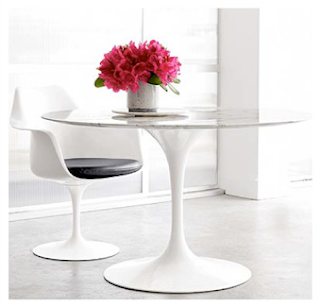

To a designer, getting a picture of Saarinen's Tulip line is the junkmail equivalent of hearing Abbey Road on the train because someone's ipod is cranked too loud. What am I supposed to do? Tell them to stop? I love it! But then again, why am I being forced to fetishize this? Saarinen is one of my heros; as a child, I made my first wages in nickels cleaning my father's white Tulip chair with Fantastic. Still, I cannot praise Saarinen tonight. I must resist temptation and vanity. But it's so beautiful, my precious....

Seriously though, let's talk about waste and wasted opportunities. Today, Saarinen's TWA terminal at JFK lies abandoned except to wilding hippies who manage to throw elite parties there. (At least that's the most recent activity of which I've heard. I wasn't invited.)
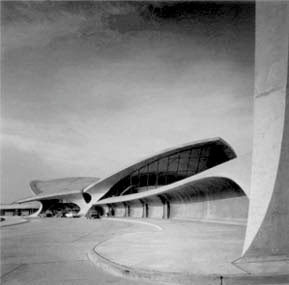

We can blame the tragedy of this wasted gem of modern architecture on the failed business practices of TWA, OR we can blame its vacancy of the inability of its design to remain a viable transit hub for a new airline in today's traffic of air travel. Yes, yes, it's my favorite building in New York, second only to... but its flaws must be reckoned with, and Eero's shortsightedness along with them. I suggest we take a look at some triumphs of long term vision in New York design.

We begin in 1832. A Cholera epidemic has erupted in London, the result of contaminated drinking water from the Broad Street Pump. Similar outbreaks occur in New York City. In 1835, the Great Fire of New York wipes out large parts of the city, burning to the ground the newly framed wooden homes of the city's immigrant poor. Insufficient water supply was blamed for the failure to extinguish the inferno. In 1837, in response to mounting concerns about disease and fire, Municipal Engineers in NYC damn the Croton River to create the Croton Resevoir, and dig an elaborate water distribution system to supply water to the growing population of the city. These were thinkers of enormous imagination. They pushed for a scale of construction and innovation unthinkable at the time. (Look at the little dude in the huge tunnel!)


These are the very tunnels that continue to drip and quench us today— 8 million strong! That's forward thinking.

Let's flash-forward to 1930 when a New York urban planner, without a driver's license mind you, envisioned our city consumed by automobiles— the mass transportation means of the future. Robert Moses gave us inner-city transit ways like the BQE, Henry Hudson Parkway, Belt Parkway, and the Triborough Bridge among others.
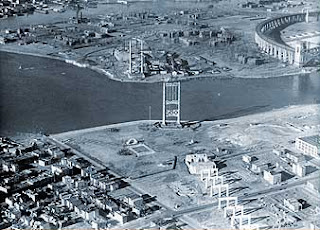

Thank god he was stopped before unleashing his dream of a freeway across Canal St. (I reveal my elitist attitudes.... He left us Soho. Errr. I have second thoughts...) Moses is often hated for ripping through working class neighborhoods to provide leisurely paths of driving for those with cars. Of course he saw it as leisurely— he never drove himself. His roads remain with us, but alongside are countless poor neighborhoods, often attributed to his developments, which are slowly returning from generations of urban blight. So here's my Colbert "Tip of the Hat" to Moses for creating roadways that continue to be used and wanted, and "Wag of the Finger" for roadways that continue to bypass, alienate, and waste working people needed for our city's growth. To boot, his visions encouraged decades of oil and auto lobby interests, resulting in our current air quality and climate dilemma.

But then there's Mies. Pretty, utopian, fascist Mies and his Seagram Building, all too overlooked for its role in Stanley Kubrick's 2001.
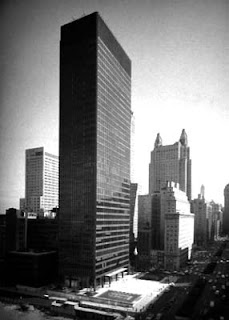

Long story short, in 1958 Ludwig Mies van der Rohe convinced a rich and greedy tycoon to forfeit almost one half of his Park Avenue lot to public space. Unconscionable! From my measly perspective, the only blindspot in his foresight is that he would be less thoughtfully imitated. Park Avenue is now lined with ugly step-back boxes of glass pushed up against the sidewalk. There is no public space except for that left by Mies in '56.

How wonderful was his foresight though, that our crowded mid-town has an oasis of flowing Croton water for the pleasure of those who drive upon and sleep beneath the roads of Moses. For the cost of height, Mies gave open space. The Seagram Building is an enduring success of municipal design. It houses the man and hosts the working stiff. No municipal or technological revolution, nor increase in corporate trading has rendered its generous space out of date.

We return to DWR and poor Eero, whose airline terminal was lyrical, but insufficient over time. Perhaps he was too concerned with his own gestures— his planes and curves, his organic twistings within. Perhaps he was not yet related to air travel and its customers. So to DWR, learn from Saarinen and Moses; some designs of the future are fated to fail and others to succeed while they fail others. Let's look to Croton and Mies for the foresight to provide infrastructure and design to all who need it. And when we take a little here for one party, lets give a little back to the other.

Dear DWR,
Please tell me in your next junkmail how you are working to support public education of design history while disseminating consumer suggestions for sustainable living.
Sincerely,
Ringleader